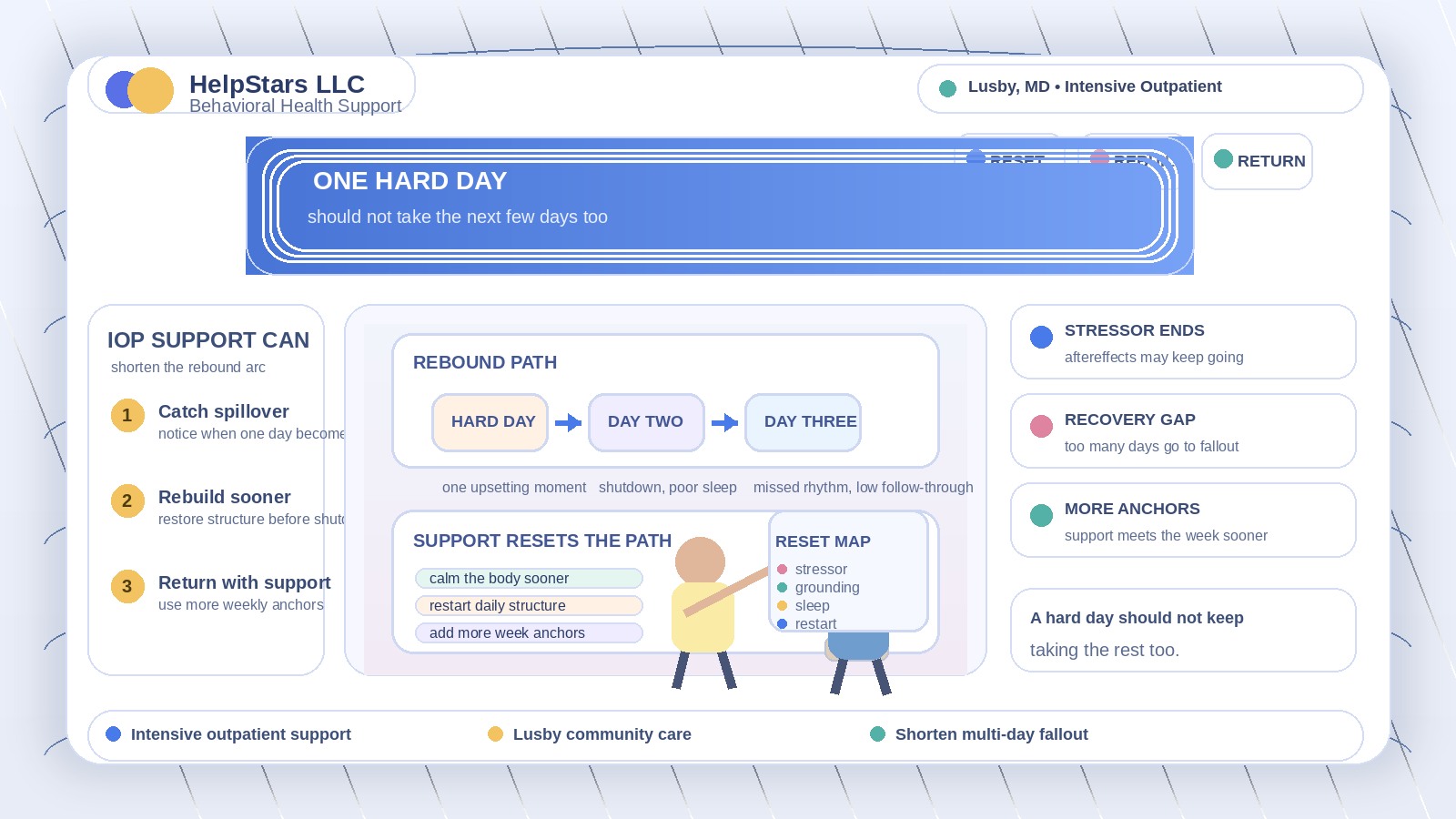
The Problem Is Not One Hard Day. It Is How Long It Takes To Come Back From It: Intensive Outpatient Support for Adults Serving Lusby, Maryland
Some adults can handle a hard day while it is happening. They get through the call, the appointment, the conflict, the bad night of sleep, or the sudden wave of anxiety. The harder part comes afterward. One rough morning can throw off the next afternoon. One upsetting conversation can drain the rest of the evening. A stressful day at work can keep the body on alert long after the actual problem is over. By the time the person begins to feel steadier again, another hard moment is already arriving.
For adults seeking intensive outpatient support serving Lusby, Maryland, that pattern may matter as much as the original stressor. The issue is not only what happens on the hard day itself. The issue is how long recovery takes, how much daily functioning disappears in the process, and how quickly the next disruption builds on top of the last one. Intensive outpatient program support can help adults who do not simply need occasional encouragement, but a stronger treatment rhythm for regaining stability after each setback.
HelpStars LLC serves adults and families across Southern Maryland with compassionate behavioral health support. When a person keeps losing multiple days to the aftereffects of one hard moment, a more structured outpatient level of care may be worth exploring.
Some Adults Are Not Only Struggling With Stress. They Are Struggling With Bounce-Back Time.
People often judge themselves by whether they got through the stressful event. From the outside, that can look like success. They went to work anyway. They finished the appointment. They made it through the family conversation without leaving. They picked the kids up, answered the text, or made dinner. But the inside cost shows up later.
That cost may look like a second day spent emotionally raw, a third day spent avoiding people, a night of poor sleep that makes the next morning harder to start, or a lingering shutdown that turns basic tasks into something heavy and difficult. In that situation, the main problem may not be that stress happens. The main problem may be that recovery now takes too much of the week.
Why Slow Recovery Can Quietly Shrink a Person’s Life
When bounce-back time gets longer, adults often start making their world smaller without meaning to. They stop committing to plans because they are not sure how wiped out they will be afterward. They delay errands until they feel more settled. They keep conversations shorter. They avoid situations that carry even moderate emotional risk because there is no extra margin left for recovery.
Over time, life can start organizing itself around prevention and repair instead of participation. A person may not look like they are in nonstop crisis, but more and more of the week is spent bracing, decompressing, or trying to climb back to baseline. That is exhausting in its own way, and it can make ordinary responsibilities feel harder to hold.
What Intensive Outpatient Support Can Add
Intensive outpatient support can be helpful when an adult needs more structure, more repetition, and more support points across the week than standard outpatient treatment alone is providing. The value is not only that help exists. It is that help appears often enough to support recovery before each setback grows into a longer slide.
Depending on the program and the person’s needs, IOP may help adults:
- recognize when a hard moment is becoming a multi-day unraveling pattern,
- practice calming and coping tools before the body stays activated for too long,
- rebuild daily structure sooner after a setback instead of waiting for motivation to return on its own,
- reduce the gap between stress, support, and recovery,
- make treatment more active across the days when functioning usually narrows, and
- turn emotional rebound into something practiced instead of something hoped for.
The goal is not to remove every difficult day. The goal is to shorten how much of life each difficult day is allowed to take with it.
A Lusby Example: The Event Ends, but the Week Stays Hijacked
Imagine an adult serving Lusby, Maryland and nearby Calvert County communities who has one especially stressful morning. Maybe a work conflict hits before noon. Maybe they leave a psychiatric appointment with more emotion than expected. Maybe a family conversation opens up fear, guilt, or irritation they thought they had under control.
They keep moving through the day, but everything after that takes more effort. That evening they are too keyed up or too emotionally drained to do much else. Sleep is off. The next day feels foggier. Messages go unanswered. Plans feel heavier than they should. By the second or third day, the original event is technically over, but the person is still living inside the aftermath.
When this happens repeatedly, the real issue may not be one dramatic incident. It may be that the nervous system and coping structure are no longer resetting fast enough on their own. Intensive outpatient support can help when a person needs more frequent care to keep one hard day from turning into a longer loss of function.
Four Signs Recovery Time May Be the Real Problem
- The stressful event ends before the distress does. The body, mood, or daily functioning stays activated well after the moment has passed.
- One difficult day keeps spilling into the next two or three. The pattern is not only intensity. It is duration.
- Daily tasks are getting arranged around decompression. More of life is being postponed because the person needs longer to come back online.
- You keep rebuilding from the same kind of setback. The issue is no longer occasional disruption. It is how often recovery keeps consuming the week.
These signs do not automatically mean one program is right for everyone. They do suggest that the timing and intensity of support deserve a closer look.
Why More Frequent Structure Can Matter
Adults often assume they should be able to bounce back faster through insight alone. But knowing what happened is not always enough to shorten the fallout. Some people need more repetition, more guided practice, and more treatment contact across the exact stretch of days where they usually lose traction.
That is where an intensive outpatient program Calvert County search may come from. A person may not be asking for the highest level of care. They may be asking for a stronger bridge between one destabilizing moment and the next attempt to function normally. More frequent outpatient support can help keep the recovery window from stretching so wide that it swallows the rest of the week.
Questions Adults May Want To Ask Themselves
If someone is wondering whether the current support rhythm is enough, it may help to notice:
- how long it takes to feel emotionally usable again after a hard day,
- whether sleep, communication, chores, work focus, or appetite reliably drop off after stress,
- how many days of the week are being spent recovering instead of participating,
- whether the same kind of setback keeps creating the same narrow version of life, and
- whether more structured support could help recovery happen sooner and more consistently.
These observations can make it easier to see that the concern is not only symptoms in the moment. It may be the size of the recovery gap afterward.
Why This Matters for Adults Serving Calvert County
For adults serving Lusby, Prince Frederick, Huntingtown, Dunkirk, and nearby Calvert County communities, mental health strain often has to coexist with commuting, parenting, work demands, household tasks, and everyday responsibilities that do not pause just because one day went sideways. When recovery stretches across several days, those responsibilities pile up fast.
A more structured outpatient level may help because it gives adults more support inside the part of the week where they usually disappear into fallout. Instead of waiting for the nervous system to settle on its own, the person may have more chances to reconnect with skills, structure, and treatment support before another difficult day lands on top of the last one.
Common Questions About Intensive Outpatient Care
Does needing more support mean I am in crisis all the time?
No. Some adults consider IOP because hard moments have started taking too much recovery time, not because every hour is equally severe.
What if I can get through the stressful event but fall apart afterward?
That still matters. The aftereffects of stress can be just as disruptive as the event itself when they keep consuming the next few days.
Can IOP help if the problem is repeated setbacks instead of one constant mood?
Yes. More structured outpatient support may help adults whose main difficulty is how often stress keeps knocking them out of rhythm for longer than it used to.
What if I already understand my triggers?
Understanding triggers is useful, but some adults still need more frequent support to shorten the recovery arc and rebuild functioning more reliably.
A Hard Day Should Not Keep Taking the Rest of the Week
Some adults are not only asking, “Why did that upset me so much?” They are asking, “Why am I still trying to come back from it three days later?” That question can point to a need for more structure, more practice, and more support across the week.
HelpStars LLC serves adults and families across Southern Maryland with compassionate behavioral health support. For adults seeking intensive outpatient support serving Lusby, Maryland, a more structured outpatient rhythm may help one difficult day stop taking the next several days with it.