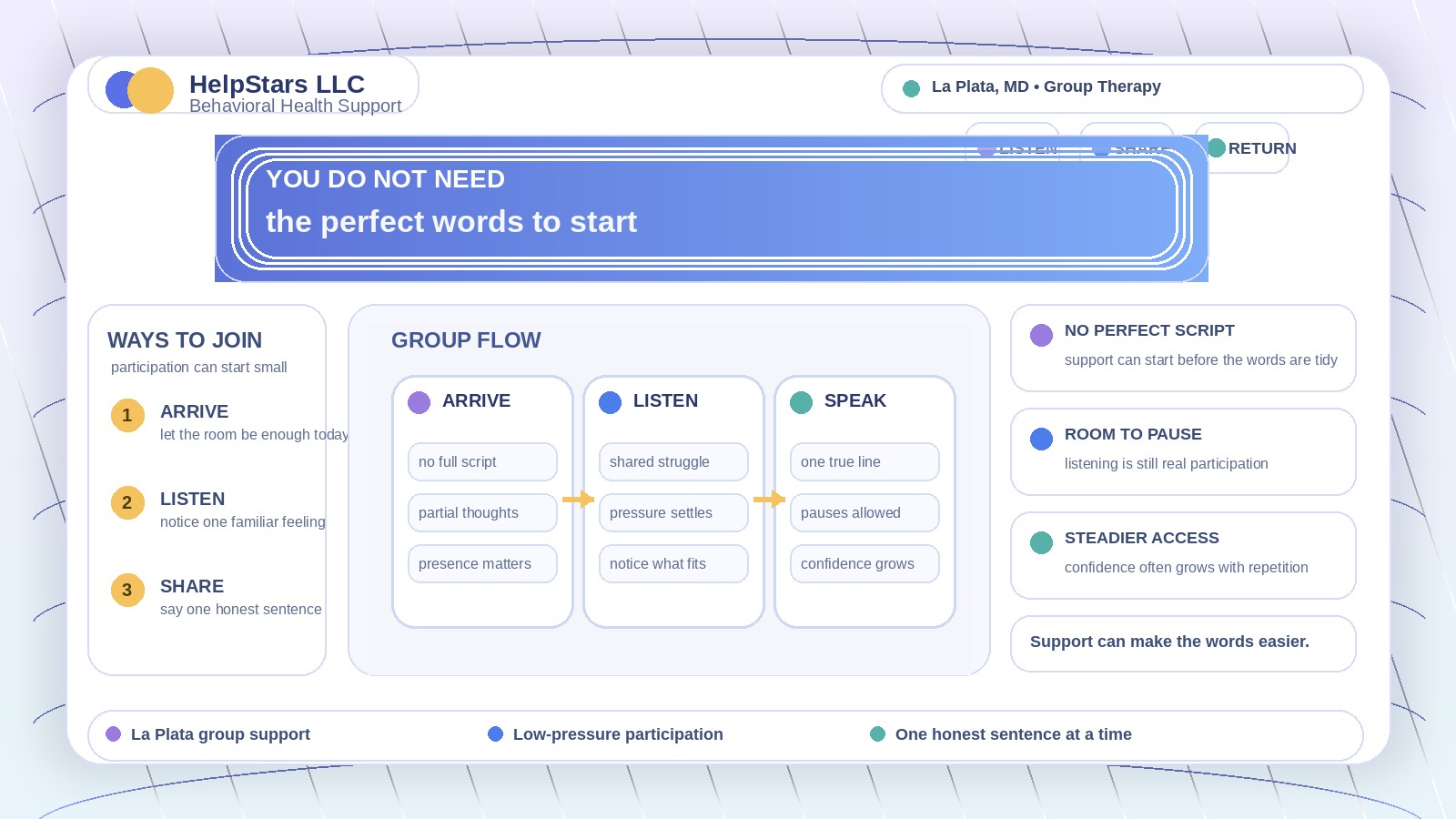
You Do Not Need the Perfect Words To Start in Group Therapy: Group Therapy for Adults Serving La Plata, Maryland
Some adults put off group therapy because they assume they need to arrive ready to explain everything clearly. They imagine having to tell a full story, say something meaningful right away, or sound more certain than they actually feel. But many people who could benefit from support are not avoiding connection because they have nothing to say. They are avoiding it because the pressure to say it well feels too high before they even walk into the room.
For adults seeking group therapy serving La Plata, Maryland, that hesitation can matter more than people realize. The barrier is not always whether support is wanted. Sometimes the barrier is the belief that showing up only counts if you can speak smoothly, summarize the week, and make sense on demand. Group therapy can offer a different kind of space—one where listening, settling in, and speaking in smaller steps still count as real participation.
HelpStars LLC supports adults and families across Southern Maryland with compassionate behavioral health services. When the pressure to explain yourself perfectly keeps becoming one more reason to stay home, structured support may help make the room feel more usable again.
The Pressure To Sound Ready Can Keep People From Starting
Many adults already know the feeling. You want support, but the minute you picture being asked how you are doing, your mind starts scanning for the right version of the answer. Too short sounds evasive. Too long sounds messy. Too emotional feels exposed. Too calm may make the struggle seem less real. By the time you have rehearsed all of that, the idea of joining a group can feel heavier than it should.
That pressure often sounds like:
- “I do not know how to explain the week without starting in the middle,”
- “By the time it is my turn, I forget the part that mattered,”
- “I can talk after I trust people, but not right away,”
- “I need help, but I do not want to sound scattered,” or
- “If I cannot say it well, I would rather not start at all.”
These are not signs that someone is unwilling to engage. They are often signs that vulnerability and self-consciousness are colliding at the same time. The person is not empty. They are overloaded by the demand to be coherent while still feeling exposed.
Group Therapy Does Not Require a Polished Update
One of the most important shifts for many adults is realizing that group therapy is not a performance. It is not a contest for the clearest summary or the strongest insight. People can benefit even when they begin more quietly. Sometimes the first useful step is simply staying in the room long enough to notice that not everyone speaks in perfect paragraphs and not every meaningful contribution arrives on schedule.
In a well-structured group, participation can look different from day to day. A person may listen closely one session, name one honest sentence the next, and later find themselves speaking more freely than they expected. That matters because some adults do not need pressure to “open up.” They need enough steadiness to stop bracing against the moment they might be asked to.
Why Adults Often Think of the Right Words Too Late
For many people, the real problem is not lack of insight. It is timing. The thought that would have been useful often arrives fifteen minutes later in the car, during a shower, while unloading groceries, or once the nervous system has finally settled down. In the moment, the brain may feel split between listening, monitoring how others see you, deciding how much to reveal, and trying not to lose the point. That is a lot to hold at once.
When that happens repeatedly, adults may start assuming group settings are not for them. But often the issue is not inability. The issue is that pressure interferes with access. Group therapy for adults serving La Plata, Maryland may help by making room for the fact that meaningful communication does not always arrive instantly. Support becomes more realistic when it recognizes how anxiety, depression, low confidence, trauma-related vigilance, or mental fatigue can slow the path between feeling something and saying it out loud.
What Group Therapy Can Offer Beyond “Just Talk More”
Group therapy can be useful because it gives adults repeated chances to practice being present without needing every moment to go perfectly. Depending on the group structure and the person’s needs, support may help with:
- reducing the all-or-nothing pressure around speaking,
- learning that listening and reflecting are still part of participation,
- noticing common patterns in how stress affects conversation and connection,
- building tolerance for sharing one real sentence instead of waiting for the perfect explanation,
- hearing familiar struggles named by other adults in a way that lowers shame, and
- gaining steadier confidence through repeated, structured contact rather than one forced breakthrough.
The goal is not to make every person equally talkative. The goal is to help the room become a place where support is still possible even when words feel delayed, incomplete, or harder to organize than usual.
A La Plata Example: The Whole Drive Home Is Full of the Things You Meant To Say
Imagine an adult serving La Plata, Maryland and nearby Charles County communities who genuinely wants more support but dreads the moment attention might turn toward them. They join a session already mentally rehearsing what to say. As others speak, they connect with parts of the conversation, but they also start comparing themselves. Their own thoughts become harder to hold onto. When they finally do speak, they give a shortened version because they do not want to take up too much space or sound disorganized.
Then the drive home tells the truth. The fuller answer shows up afterward: what actually hurt that week, what they were too embarrassed to admit, what part of someone else’s story sounded painfully familiar, what question they wish they had asked, what they are still carrying. Now the thoughts are available, but the room is gone.
That kind of experience does not mean group therapy failed. It often means the person needs support that respects how slowly safety and verbal access can build. With time, structure, and repetition, many adults find that the words start arriving earlier—or that they no longer need the words to be perfect before they count.
Three Smaller Ways To Participate That Still Matter
- Notice one part that felt familiar. A person does not need a full speech to say, “That part sounded like me.” Recognition can be a meaningful starting point.
- Name one present-tense truth. Something as simple as “I am here, but it is hard to organize my thoughts today” can create more honest support than a polished summary that hides the real struggle.
- Let the session count even if it felt imperfect. Adults often underestimate the value of showing up, listening, tracking others, and staying connected long enough for trust to build.
These smaller participation patterns matter because they lower the false standard that healing only counts when it sounds eloquent.
Why This Can Matter in Everyday Charles County Life
Adults serving La Plata, Waldorf, White Plains, Bryans Road, Indian Head, and nearby Charles County communities are not trying to find the right words in empty space. They are doing it while managing family stress, work pressure, appointments, transportation, interrupted sleep, financial strain, and the ordinary fatigue of getting through the week. When communication already feels effortful, group settings can seem intimidating unless the expectations are realistic.
That is one reason structured behavioral health support can matter. A person may not need more generic advice to “open up.” They may need an environment where showing up as they are—not as a cleaner, faster, more prepared version of themselves—still creates room for progress.
Questions Adults Often Ask About Group Therapy
What if I am not comfortable talking a lot right away?
That does not automatically mean group therapy is a poor fit. Many adults begin more quietly and participate more naturally as the setting becomes more familiar.
Do I need to have a clear story prepared before I join?
No. Many people come in with thoughts that feel partial, out of order, or unfinished. Support can still be meaningful without a polished explanation.
What if I always think of the important part after the session ends?
That can be part of the pattern group therapy helps bring into clearer focus. Some adults need repeated practice in connecting inner experience to spoken words while they are still in the moment.
Can group therapy fit alongside other outpatient behavioral health care?
Yes. Depending on the person’s needs, group therapy may be one part of a broader outpatient plan that also includes counseling, psychiatric evaluation, medication management, PRP, family support, or other behavioral health services.
Support Still Counts Before the Words Feel Perfect
Some adults stay farther from help than they want to because they think support begins only after they can explain themselves well. But for many people, the more accurate truth is the opposite: the words get easier once support begins.
HelpStars LLC supports adults and families across Southern Maryland with compassionate behavioral health services. For adults seeking group therapy serving La Plata, Maryland, a structured group setting may help reduce pressure, make participation feel more possible, and turn delayed thoughts into steadier connection over time.